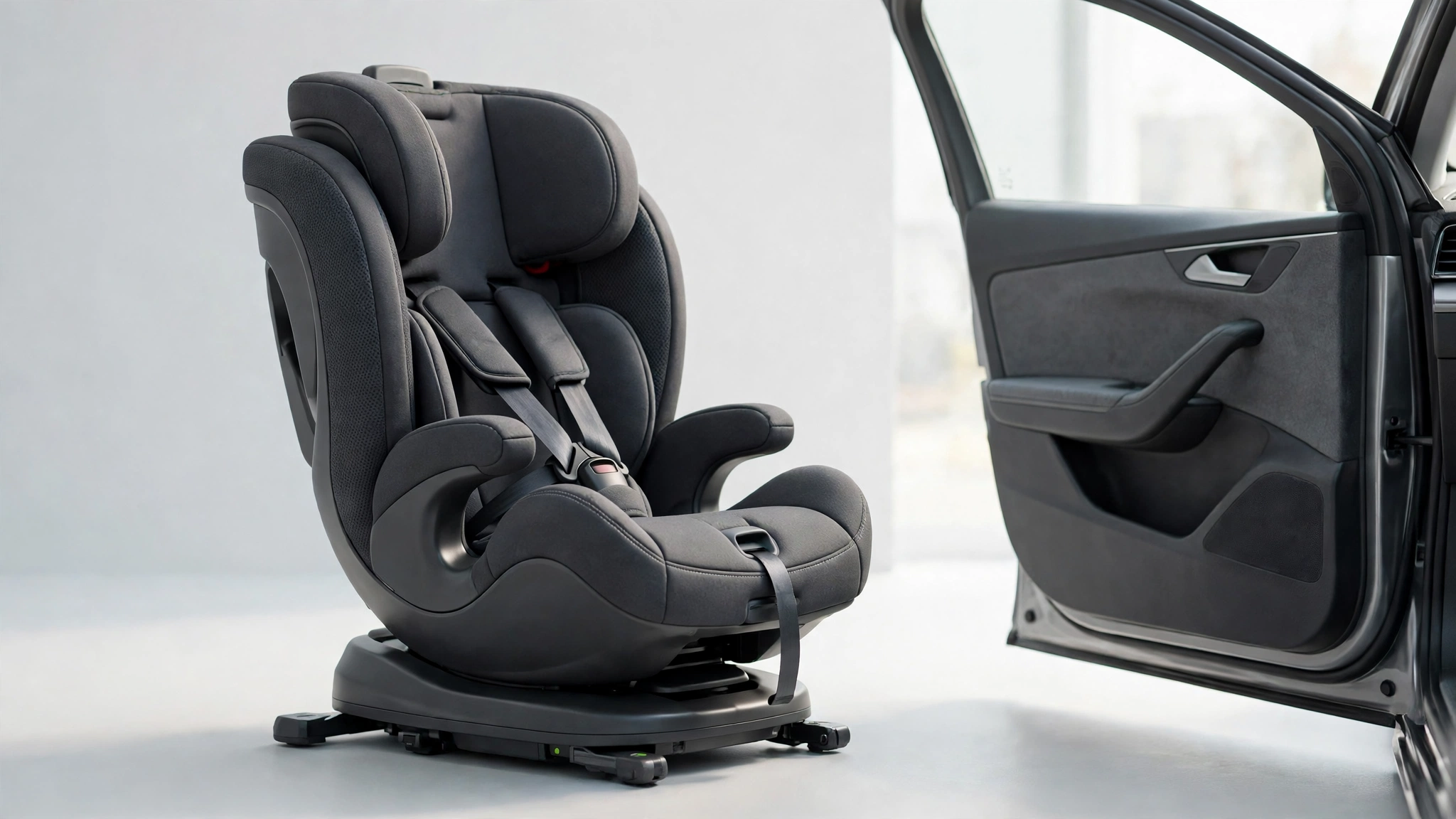
A 360 rotating car seat is not automatically safe, and a swivel function is not a safety approval. Whether a specific seat can be used safely depends on the exact model, the standard and destination market it is approved for, whether it fits the child and the vehicle, and whether it is installed, locked, and used as that model’s manual requires.
The checks below apply to any rotating model. Later sections add practical steps for parents and caregivers, and additional document checks for retailers and importers.
The image at the top of this page is a studio illustration. It shows a rotating car seat standing on the floor beside a car door, not a seat installed in a vehicle. It is not an installation demonstration and is not evidence of approval or testing.
About the Author — Mr. Liam Xie, Holdum
Child car seat structural engineer. Nearly 20 years in the industry, 100+ models developed, former R&D Director at several of China’s leading child safety seat manufacturers. Products he developed were sold in Europe, Southeast Asia, Australia and the US.
Check Approval for the Exact Model and Market
Check the approval for the exact model and destination market, including the model’s approved locking design and installation requirements. Confirm that the seat you have — or the unit on a retail shelf — matches the approval documents for that market. Holdum publishes model-level approval status on its certifications page; use that listing as a starting point, then confirm the certificate and the approval mark on the seat.
ECE R129 and i-Size Are Related, Not Interchangeable
In markets that use UN type-approval, many rotating seats are approved under UN Regulation No. 129 (often called ECE R129). i-Size is a category name used for certain seats approved under that regulation, not another name for the whole regulation. An i-Size label is not proof that every R129 seat is an i-Size seat, or that a seat is approved for every market.
Always match the certificate and the approval mark on the seat to the exact model and destination market. In the United Kingdom, official guidance says you can choose a child car seat based on the child’s height or weight. For height-based seats, only approved seats may be used, and these have a label showing a capital “E” in a circle and “R129”. For weight-based seats, only approved seats may be used, and these have a label showing a capital “E” in a circle and “ECE R44”. This official guidance concerns use. It should not be read as a rule on what may be sold.
If a seat is described as i-Size, still check the model manual and vehicle fit list for support-leg clearance, seat contour, and cabin space. That description does not replace a vehicle-specific fit check.
Match Approval Documents to the Exact Model
Do not rely on a generic family certificate. Check that the paperwork refers to the same model, base, and configuration as the seat you intend to use or sell.
- Check the Approval Mark: verify that the circle “E” mark and approval number on the seat label match the type-approval certificate supplied by the manufacturer.
- Cross-Check the Base Assembly: Ensure the test or approval file reflects the specific integrated rotation base rather than a stationary variant.
- Verify Weight and Stature Ranges: Confirm that the certification document covers the child height or weight limits listed in the product user manual for that model.
Lock the Seat and Install It as the Manual Requires
A rotating seat must be locked into a permitted travel position before the vehicle moves. Follow the locking and installation steps in the exact model manual.
The rotation lock is what keeps the shell from remaining free to turn, including in the side-facing loading position, while the vehicle is moving. Some models include visual or audible cues for that lock. Use the indicators specified for that model; do not assume every seat uses the same colors or signals, and do not treat an ISOFIX, support-leg, or tether indicator as a rotation-lock confirmation unless the manual says it is.
| Feature Component | Safety Function | Misuse Risk |
|---|---|---|
| Rotation Lock Mechanism | Engages the shell into locked rearward or forward modes | Traveling while unlocked or in loading mode |
| Lock Indicator | Provides immediate visual feedback when that model includes a color indicator | Ignoring the indicator or assuming a lock without a click or confirmation |
| Anti-Rebound Bar / Base | On designs that include one, limits rearward rebound of the shell toward the vehicle seatback after a frontal impact | Assuming every rotating seat has the same bar or base layout |
ISOFIX, Support Legs and Top Tethers: Follow the Specific Design
A rotating seat base has to manage crash forces through the installation system approved for that model. Many 360 rotating car seats use ISOFIX — the rigid anchor system built into the vehicle — rather than a vehicle seatbelt alone. The correct combination depends on the model, not on a single preferred setup.
- ISOFIX Anchors: Where specified, swivel seats connect to vehicle ISOFIX anchor points. Rigid ISOFIX attachments can reduce installation slack, but only when they are used as the model manual and vehicle fit information require.
- Support Leg Systems: Some rotating models use an extendable support leg that rests on the vehicle floor. Use a support leg only when that model is designed and approved with one, and only as the manual specifies.
- Top Tethers: Other rotating models use a top tether as the anti-rotation device. A support leg and a top tether are not interchangeable. Follow the exact anti-rotation design approved for that model; do not assume one configuration is preferred for every 360-degree seat.
Confirm Vehicle Compatibility Using the Model Manual
A rotating seat can only work as intended if it fits the vehicle and is installed as the manual requires. Use the vehicle fitting information issued for that model together with the product manual, so the seat is fitted in a permitted position for that vehicle.
- Underfloor Storage Compartments: Support legs must never rest on hollow floor storage lids unless the model manual and vehicle information allow a specified filler block or alternative method.
- Vehicle Seat Angle: Deeply contoured or sloping vehicle seats can alter the recline angle, requiring careful base adjustment as the manual describes.
- Cabin Clearance: The clearance needed to complete a 90-degree turn to the door depends on vehicle door-frame dimensions and front-seat positioning.
What Parents and Caregivers Should Check
These checks are for daily selection and use. They do not replace the model manual, and they are not a claim that any rotating seat is safe in every car or for every child.
- Confirm the seat is approved for your country. Look at the label on the seat for the required approval mark. In the UK, official guidance says you can choose a seat based on the child’s height or weight: approved height-based seats show a capital “E” in a circle and “R129”, and approved weight-based seats show a capital “E” in a circle and “ECE R44”.
- Install the seat only as the model manual and vehicle information allow. Check every indicator the manual names. ISOFIX, support-leg, top-tether, and rotation-lock cues may be separate, and one green signal does not automatically confirm the others.
- Lock a permitted travel position before you drive. The 90-degree swivel toward the door is for loading and buckling only. A child must never travel with the seat left in that side-facing position.
- Use the harness as the manual requires. The swivel can make it easier to route and tighten the straps. That convenience helps only when the harness is used correctly for that model.
- Follow rear-facing limits for both the model and the market. Stay within the approved rear-facing range in the model manual. In the UK, height-based seats must be rear-facing until the child is over 15 months old. In the United States, the American Academy of Pediatrics recommends that infants and toddlers ride rear-facing as long as possible, until they reach the highest weight or height allowed by the seat’s manufacturer. These rules and recommendations are market-specific; they do not override a model’s approved limits, and they do not apply automatically in every country.
- When a child outgrows a mode or the seat, follow the model manual and the destination market’s rules for the next stage of restraint. For multi-stage designs such as a 3-in-1 rotating car seat, check the limits that apply to each mode before you turn the shell forward.
Additional Checks for Retailers and Importers
When you source a rotating car seat, start with the compliance paperwork for that exact model and market. Before placing an order, ask the supplier for records that match the exact model and destination market, and for a demonstration of the rotation lock.
| Document or check item | What the buyer should verify | What must match the model and destination market |
|---|---|---|
| Type-approval certificate | A valid approval certificate under the regulation required for the destination market, such as ECE R129, or i-Size where that category applies. | Model number, trade name, manufacturer details, and approved configuration must match the product label exactly. |
| Approval mark on the seat | The circle “E” mark or equivalent market mark is present, readable, and consistent with the certificate. | The mark, approval number, and category must belong to the exact model and base being shipped. |
| Dynamic test documentation | The official test coverage that forms part of, or accompanies, the type-approval file for that model. Check which impact tests and orientations are included rather than assuming frontal and side-impact tests cover every orientation in every case. | The test file must describe the same rotating base and travel positions as the unit you intend to sell. |
| Rotation-lock documentation | Supplementary mechanism or durability records for the swivel hub and lock, where the manufacturer provides them. These files are useful when available; they do not replace the type-approval certificate. | The description must match the lock design on the production model, including permitted travel positions. |
| Conformity of Production records | Evidence that ongoing production is kept in line with the approved type, when the supplier provides COP records. | The records should refer to the same approved model, not a related but uncertified variant. |
| Manuals, labels, and vehicle fit information | The user manual, warning labels, and vehicle fitting information issued for that model. | Installation method, anti-rotation device, stature or weight range, and language coverage must match the destination market and the exact SKU (stock-keeping unit). |
Train store staff to demonstrate correct use according to the manual for that model, including these points:
- Driving in the 90-degree loading position: The side-facing angle exists strictly for boarding and buckling. A car seat must never travel in the loading position. Travel is limited to the rear-facing or forward-facing orientations permitted for that model.
- Partial rotation lock engagement: If an end user does not rotate the seat until the mechanical latch clicks or the specified indicator confirms a lock, the seat may remain free to swivel. Use the visual or audible lock cues described in the model manual.
- Premature forward-facing transition: The swivel makes it easy to turn a child forward. Retailers should highlight the rear-facing height, age, or other thresholds stated in the model manual and destination-market rules before the shell is turned forward.
- Ignoring base indicators: Check that the ISOFIX connectors and any required support leg or top tether are correctly secured, following the model manual. Use every indicator named in the manual.
What Should a Retailer Do If a Supplier Cannot Provide a Document?
Do not stock a model for a market if the required type-approval certificate, the matching approval mark, or the manuals, labels, and vehicle-fit information for that exact model and destination market are missing. Ask the supplier for those files by name and confirm they cover the unit you intend to sell. Rotation-lock records and other supplementary manufacturer test files are useful when they are available, but they are not a substitute for the required approval documents, and the absence of a supplementary file is not by itself the same as a missing type-approval certificate. If the required approval file cannot be provided, treat the model as unverified for that market and shortlist a model whose required file is complete.
For more questions about ordering, sampling and delivery, see our FAQ.
Frequently Asked Questions About Rotating Car Seat Safety
Are Rotating Car Seats Safer Than Non-Rotating Seats?
Rotation is not proof that a seat is safer or less safe than a non-rotating seat. Compare the exact model’s approval, permitted travel positions, and installation requirements. Any practical benefit from easier harnessing or rear-facing use depends on correct use and on the rules that apply to that model and market.
Can a Child Travel in the Side-Facing Loading Position?
No. A child must never travel with the seat turned 90 degrees toward the vehicle door.
- The side-facing orientation is intended strictly for loading and unloading.
- The rotation lock must confirm a permitted rear-facing or forward-facing travel position before the vehicle moves, using the click, indicator, or other cue specified in the model manual.
- Traveling sideways is not a permitted travel position and does not provide the restraint path the seat is approved for.
How Long Should a Child Ride Rear-Facing?
Follow the approved rear-facing range in the model manual first. In the UK, height-based seats must remain rear-facing until the child is over 15 months old. U.S. pediatric guidance recommends staying rear-facing as long as possible, up to the highest weight or height the manufacturer allows. Check the rules that apply in the destination market; they can differ, and they do not extend a seat beyond its approved limits.
Next Steps
For daily use, follow the model manual and the destination-market rules that apply to that seat. To review Holdum models, browse our 360 rotating car seats range, or contact Holdum if you need information for a specific model.
Retailers and importers should use the document checklist above, then contact Holdum for the matching documents available for that model, including relevant records from Holdum’s quality control process. You can also review the certifications record or continue to the 360 rotating car seat buyers guide for retailers.
Related Sources
- UN Regulation No. 129 (EUR-Lex, OJ L 2026/1534) — Official Journal publication of UN Regulation No. 129, the UN type-approval regulation for enhanced child restraint systems. This Official Journal text is a consolidated documentation version, incorporating amendments through Supplement 4 to the 04 series of amendments. Only the original UN/ECE texts have legal effect under international public law; confirm the current official version and series of amendments on the source page.
- GOV.UK — Child car seats: the rules — UK government rules on using child car seats, including approved height-based (R129) and weight-based (ECE R44) seats, rear-facing until over 15 months for height-based seats, and fitting requirements.
- HealthyChildren.org (American Academy of Pediatrics) — Rear-Facing Car Seats for Infants and Toddlers — U.S. pediatric guidance on why children should ride rear-facing as long as possible, within the limits of the seat.
- Child Car Seats UK — Fitting child car seats — Independent UK guidance on fitting child car seats correctly, including ISOFIX, support legs and top tethers.
- ADAC Kindersitztest — Independent child seat test results and ratings.